From Shadows to Sunshine: Why Active Listening is So Important - My Story
I want to be very clear, this is not my usual market commentary, this is me sharing my mental health journey, since it is being laid on my heart to share this. I feel as if someone, somewhere out there, is hurting, and I want to speak directly to you throughout this post. I am here for you, no matter what. If I can do it, so can you. I am writing this as openly as I can be, on purpose, for the sole fact that I feel as if I need to. I have learned the hard way that silence can be lethal, and if we find a true connection and a solid support system, it can be a medicine that our souls need. Before I hop into this post, if you are reading this and carrying something heavy on your hearts, I want you to know, up front, that you can talk to me. Although I am not a clinician, I am here, and I will listen without judgment, and I will help you get connected to someone who can help.
I want to take a break from the market commentary for the next couple of blog posts and talk about the subject of mental health. I feel as though this does not get talked about nearly as much as it should. I know I spend most of my time on here talking about the market and all the volatility, narratives, risk, and the psychological effects/impacts it has on decision-making skills. I want to share my personal experience with mental health, discuss the daily challenges I encounter, and explain why it’s crucial to listen attentively.
Before I get into this post, I want to ask you seven words that can sound mundane or routine in a hallway setting, and something that can be honestly forgettable to most people. These seven words, you’ll come to learn in this post, actually saved my life and are the reason as to why I am still here today. “How are you? Are you doing ok?”
Most of the time, we treat this small niche phrase like a greeting, something that is polite enough to pass off without really thinking about what it means or how much it could matter to someone who’s struggling. As I said before, I am alive today because one person truly cared enough about me and meant those seven words. He did not ask them as a way to just fill the silent void between us. He asked them because he saw me, straight into my being, and saw that I was not doing ok, and he was willing to stay long enough for me to drop the façade and give him the real answer.
The world as we know it is not “fine,” and the growing numbers confirm what many of us are feeling
We live in a time where mental health illnesses are at an all-time high, and this “crisis” is not only widespread, but it is also strangely invisible (because no one wants to talk about it). Across the world today, the World Health Organization estimates that over 1.1 billion people are currently living with a mental health disorder. I want you to know that the word “disorder” does not define you as a person; it is just what the experts classify this as. In the United States alone, the National Institute of Mental Health estimates that over 23.1% of the current population experiences some type of mental health issue.
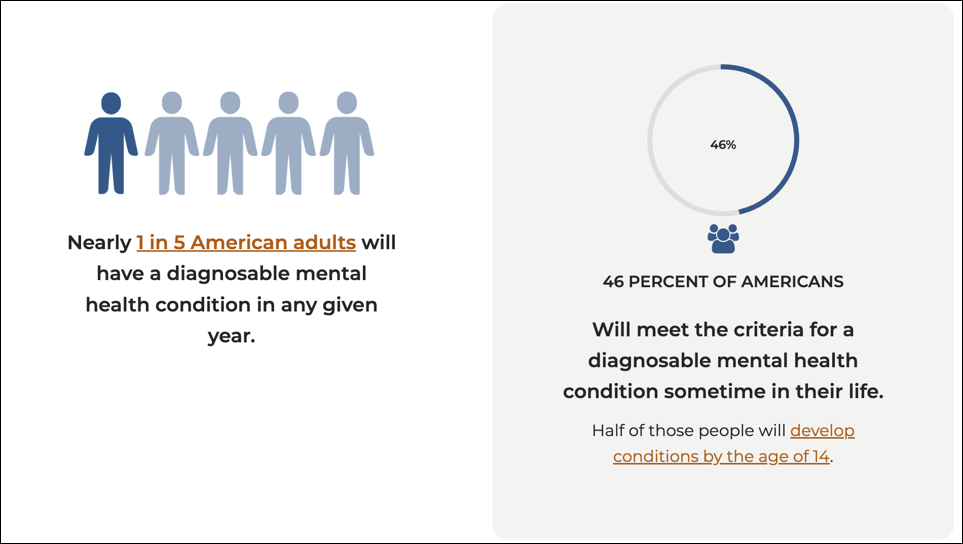
The stats alone can educate all of us on this growing issue or crisis, but honestly, in my lived experience, they cannot substitute for presence and having a strong community. I will say, however, they do matter because they tell us that this is not just a niche issue, but truly a worldwide systemic epidemic that affects 1-in-8 people. This is families. Teams. Friend groups. Barracks. Dorms. Offices. Churches. Neighborhoods. It is very likely that someone we all know is impacted by this.
When you widen the scope of the issue to suicide, the urgency becomes even harder to ignore. The CDC notes that suicide is currently the second leading cause of death for people ages 10-34 (and even remains significantly high as you age).
For me, though, the conversation is not just abstract or menial; it has names, dates, places, and people that I have loved and cared for deeply, whom I have lost, as well as a moment that nearly ended everything for me.
My “shadows” started early, but I learned to keep moving anyway
Let’s dive into my story, and I will share my mental health journey with you. Let me take you back to circa October 2018, a night that changed my life in ways I could never have anticipated. I was sitting in my barracks room in Okinawa, Japan, enjoying Popeyes and minding my own business. It was just another ordinary night until, suddenly, my face began to swell, putting intense pressure on my throat and windpipe, and breathing became a struggle. Thankfully, my roommate jumped into action, quickly contacting emergency services, and I rushed to the ER. After some fast-forwarding through the chaos, the doctors ran a CT scan on my head to figure out what was going on. The initial news was a relief: the swelling was caused by saliva gland stones lodged in the gland, something the medical team could handle without any lasting complications. But as I started to breathe easier, the doctor looked at me with that expression no one ever wants to see and said, “However, there is more.”
If you’re reading this and wondering, “Wait, there’s more?” I was right there with you. I did not want more. The doctor continued and told me I had what’s called a cavernous malformation, or CCM, inside my brain. To save you a trip to Google, a CCM is basically a tangled cluster of tiny blood vessels with thin walls. Usually, unless it starts bleeding or causes neurological issues, it’s something doctors just monitor and hope it doesn’t become a problem. But, as life often does, I was thrown a curveball. My CCM was sitting on one of the biggest venous anomalies in my brain, making surgery nearly impossible and putting me at a higher risk for dangerous bleeding. The reality hit hard; this wasn’t just a medical hurdle, it was a long-term challenge with no easy fix.
Now, you might be wondering how this unexpected health scare connects to the conversation about mental health. The answer is simple: they’re deeply intertwined. Facing a diagnosis like that can shake your foundation, and navigating the aftermath isn’t just about physical healing; it’s about mental and emotional resilience. These experiences have shaped the way I view mental health, underscoring why it’s so important for all of us to talk openly, find support, and remember we’re not alone—no matter what curveballs life throws our way.
Going back to me sitting in the ER, I immediately thought that all my goals and aspirations in life were over. Even though I had a low-to-moderate risk of hemorrhagic bleeding and was advised to cut back on physical, mental, and stressful activities, it was very hard to do. My command at the time would not let me “cut back.” I was still expected to physically train very hard, do advanced martial arts training, and remain “combat-deployable,” among other things. It was at this time that I became incredibly depressed and extremely suicidal.
Over the next few weeks and months, I thought that if I immersed myself in work, I could drown out the noise. However, as I know years later, you have to deal with the issues head-on before you can actually learn and grow from such a situation. Well, me being the stubborn person I am, I didn’t do that. I was losing hope and fast. I started to stop talking to people. The “so-called” light at the end of the tunnel was completely dark. I started drafting “goodbye” letters to my family and friends, telling them that I loved them but just couldn’t deal with the pain and grief anymore. One night, I started to plan out how I was going to “go through with it.” Being the detail-oriented person I am, I thought I had it all figured out. I planned to do it the very next day. Well, the next day came; I got up, went to physical training with my platoon, came back, showered, changed, and then headed to work. I had a very rough day that day, which, in my mind, just solidified what I was going to do that night when I got home. It honestly felt as if nothing was going my way anymore, and that I truly felt the darkness overcome me.
As I was walking out of my office (I was always one of the last ones out), I passed my “Gunny’s” office. Gunny Harris (Ryan - if you are reading this, I know I have told you several times already, but thank you again for saving my life, brother), who was one of the most down-to-earth and caring “bosses” I have ever met in my entire life, called me over to his office. He saw the “white as a ghost” expression on my face and that I was completely “out of it.” What he said to me next changed my life forever. I walked in, and he immediately asked me, “How are you doing? Are you doing okay?” At first, I tried to play it off because I didn’t think he truly cared and was just asking for his own benefit. But he saw through my “façade” and told me to have a seat so that we could talk. Within minutes, he knew something was up and that I was in trouble, all because he took time out of his day to stop me in the hall and ask how I was doing and if I was truly okay. That night, because of him, I was able to get the help I needed.
Too often, I see people complete their annual training or even specialized training on catching the “warning signs” early or the “what to do when faced with a Mental Health Event” as a check-the-box training, but then they forget it in the future. In that moment, they are so happy to do it; they think they are going to change the world because they completed this training. Great, good for them, I am happy they took this step. However, let’s fast-forward a little bit and make this personalized to each of you reading this. Let’s say a coworker stops by your office to catch up or a friend stops you on the street, and right away, you notice that something “seems off.” But because you have so much on your plate, other colleagues to meet with, meetings scheduled throughout the day, kids needing to be picked up, you decide to stay quiet, thinking to yourself, “Maybe they’re just tired” or “having a rough day.”
Ask yourself this: “Am I listening? Am I effectively doing a good job at it when I talk to others? Do I need to ask them if they are okay?”
One way to improve our listening abilities is to become an active listener. Active listening is defined as the practice of listening attentively to someone, not only understanding what they are saying but also responding and reflecting on the information being said and being attuned to their thoughts and feelings.
So many people around the world today engage in passive listening. It is basically listening without reacting and not really paying attention to what is being said in the conversation. This is one of the biggest problems facing our world today. When people talk with each other, they don’t really listen and engage on an interpersonal level when they communicate. You want to know how to solve 90+% of the world’s problems? Listen better and listen actively.
When I was thinking of a title for this post, I knew that I wanted to involve something around the idea of active listening because I personally knew from my own experience that if someone actively listens and engages with you, they can figure out very quickly whether or not someone is struggling and dealing with something big on their shoulders. If you learn and get motivated by the “why” behind “why it’s important to actively listen,” you can truly change someone’s life for the better. It also shows that you have empathy and understand that whatever someone is going through is wrecking their world, but “oh, guess what,” you are there to support them through it.
Throughout my short-lived life so far, I have been plagued with many obstacles or “shadows,” in which my life has been very dark and plagued by depressive episodes. However, I now know today that there is my own personal sunshine of hope and strength found within my own personal community. If you ask any of my friends, they will say that I lean on them for so much, and it is true because within each of us, there is our personal community that shapes who we are as individuals. It is truly because of them that I can keep going and striving toward my dreams and goals.
A friend of mine, John Teichert, who is a retired Brigadier General in the Air Force, said in his famous speech on resiliency during a mental health operational stand-down at his unit after mass suicides had plagued his military base (I am paraphrasing, of course) “In life, we are shown that the four pillars of resiliency are social, spiritual, physical, and mental, they all have a lot of value and importance to them and that they all have a big impact on the idea of resiliency. However, it’s the rarely spoken about ‘fifth pillar’ of community that truly helps those withstand the bad weather. When we have a foundation that keeps us firmly rooted in place, we are able to conquer whatever life may throw our way.”
Veterans, Quiet Reflection, and a Stark Statistic
If any of you have spent any time around service members or veterans alike, you know the culture can truly be hard to wrap your head around, we are loyal to a fault, we have the darkest humor, we strive to be competent in everything that we do, and we are purposely intense, but at the same time we have learned how to handle pain alone, and not tell anyone about it, since we do not want to look weak.
Still to this day, the statistic of “22 veterans die a day” is a harrowing, stark statistic that should be a reminder to all of us (not just veterans) to look out for our friends and family members. It is precisely here, inside this veteran reality, that active listening becomes more than a soft skill. It becomes a form of intervention.
If we, as humans, do not look out for each other, for our brothers and sisters to our left and right, and we just go about our days treating them as just another day instead of embracing the day as another day to help and be there for others, we are in the wrong business and are at risk of not seeing those who need us most, those right next to us. We are also a part of the problem instead of being part of the solution that we said we originally wanted to be a part of.
I challenge each of you to use this blog post as your personal “why” and the motivation to help change other people’s lives for the better. Don’t be so caught up in your own day that you can’t take five to ten minutes to walk around your office and talk with your colleagues or friends. Just ask those questions that I started with today to someone, and you will definitely help change someone’s life. I also guarantee you will feel better, and your demeanor will begin to change.
What active listening actually is (and why it works)
Active listening is not simply being quiet while someone talks. It is a deliberate practice: paying close attention, reflecting what you are hearing, and staying attuned to the emotion underneath the words.
If you want something practical, something you can do in a hallway, a kitchen, a text thread, here are a few principles that matter more than most people realize:
Slow down the moment. The greatest gift you can give someone in distress is time that is not rushed.
Ask real questions, and tolerate the pause. People often answer honestly only after the second or third breath.
Reflect, don’t lecture. “It sounds like you’ve been carrying this alone for a while.”
Validate the feeling without endorsing hopelessness. “That makes sense. Anyone in your shoes would feel overwhelmed.”
Stay connected and get help involved when needed. Support is not a solo mission.
And if you are ever genuinely worried someone may hurt themselves, treat that as what it is: a situation that deserves immediate professional support, not a casual check-in.
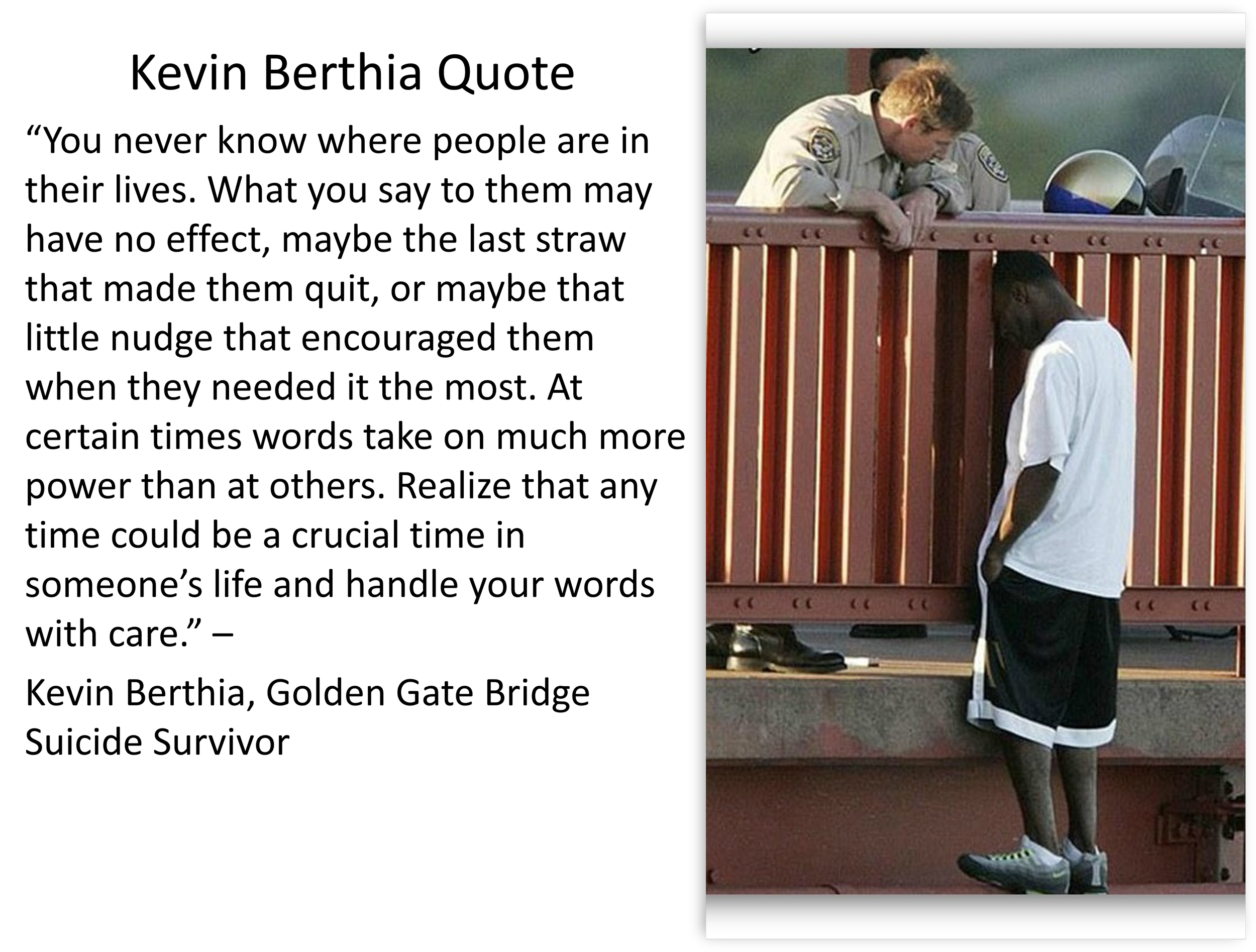
Kevin Berthia - Golden Gate Suicide Survivor
If you need help right away
If you are in need of immediate assistance, call 911 (U.S.) or go to the nearest emergency department.
Call or text 988 (Suicide & Crisis Lifeline). It’s free, confidential, and available 24/7.
Text HOME to 741741 (Crisis Text Line).
My promise, and my boundary
Now, if any of you would like someone to talk to, someone to support you, someone to lean on. If you need me or someone to be there for you, whether it’s 3 am or 3 pm, email me; I don’t care. Pick up the phone and reach out. You are not alone. I see you, I feel your pain, I’ve been there, and I am here now. I will say this, though: if you choose to call me asking for help, please note that I am not a mental health provider or practitioner, but I am someone who will sit there with you, no matter the circumstance, until professional help arrives. I used to believe survival was a solo performance: carry it, bury it, outwork it. Now I believe something different. I believe community is not a bonus; it is a protective factor. I believe listening is not passive; it is active care. And I believe the smallest questions, asked sincerely, can redirect a life.
So, I will end where I began, the same seven words that saved my life…. How are you? Are you doing okay?
If the answer is “no,” please do not disappear. Reach out. You will not be met with judgment. You will be met with presence and with help.
Here is my email: connect@connorthomaston.com
Sources: American Psychological Association. (4/19/2018). Active listening. In the APA Dictionary of Psychology. https://dictionary.apa.org/active-listening
Centers for Disease Control and Prevention. (2025, March 26). Facts about suicide. https://www.cdc.gov/suicide/facts/index.html
Garnett, M., Curtin S. National Center for Health Statistics. (2024, September). Suicide in the United States, 2002–2022 (NCHS Data Brief No. 509). Centers for Disease Control and Prevention. https://www.cdc.gov/nchs/data/databriefs/db509.pdf
Crisis Text Line. (n.d.). Crisis Text Line (Text HOME to 741741). https://www.samhsa.gov/#:~:text=Other%20resources%20include:%20*%20**FindTreatment.gov**%20Confidential%20and,24/7%2C%20365%2Dday%2Da%2Dyear%20treatment%20referral%20and%20information%20service
Johns Hopkins Medicine. (n.d.). Cavernous malformations. https://www.hopkinsmedicine.org/health/conditions-and-diseases/cavernous-malformations#:~:text=Cavernous%20malformations%20can%20happen%20anywhere,symptoms%20include%20headaches%20or%20seizures.
Johns Hopkins Medicine. (n.d.). Developmental venous anomalies. https://www.hopkinsmedicine.org/health/conditions-and-diseases/developmental-venous-anomalies#:~:text=about%20a%20DVA-,A%20developmental%20venous%20anomaly%20(DVA)%20is%20a%20problem%20with%20the,DVAs%20are%20not%20dangerous.
Kemp, J., & Bossarte, R. (2012). Suicide data report, 2012. U.S. Department of Veterans Affairs, Mental Health Services, Suicide Prevention Program. https://www.va.gov/opa/docs/suicide-data-report-2012-final.pdf
Mayo Clinic Staff. (2024, July 20). Cavernous malformations: Symptoms and causes. Mayo Foundation for Medical Education and Research. https://www.mayoclinic.org/diseases-conditions/cavernous-malformations/symptoms-causes/syc-20360941
National Institute of Mental Health. (n.d.). Mental illness. https://www.nimh.nih.gov/health/statistics/mental-illness
National Institute of Neurological Disorders and Stroke. (2025, April 9). Cerebral cavernous malformations. National Institutes of Health. https://www.ninds.nih.gov/health-information/disorders/cerebral-cavernous-malformations
988 Suicide & Crisis Lifeline. (n.d.). About 988. https://988lifeline.org/
U.S. Department of Veterans Affairs. (2024, December 19). VA releases 2024 National Veteran Suicide Prevention Annual Report. https://news.va.gov/137221/va-2024-suicide-prevention-annual-report/
U.S. Department of Veterans Affairs. (n.d.). Veterans Crisis Line. https://www.veteranscrisisline.net/
World Health Organization. (2025, March 25). Suicide. https://www.who.int/news-room/fact-sheets/detail/suicide
World Health Organization. (2025, September 30). Mental disorders. https://www.who.int/news-room/fact-sheets/detail/mental-disorders